10 minute read time.
The Teacher Comment That Changed Everything
Last fall, before starting a new professional development series with a district team of arts educators, I sent out a simple pre-workshop questionnaire. I expected the usual comments about learning styles, initial questions, and preferences.
But one response stopped me in my tracks:
“I don’t like feeling like my time is being wasted.”
That line has stayed with me, because here’s the thing: arts teachers don’t hate professional development. They hate bad PD – the kind that wastes their time, ignores their expertise, and checks a box without addressing any of their real needs.
By last fall, I had already stepped away from offering “one-and-done” professional learning workshops. So this comment felt like the confirmation that I had made the right choice and was moving in the right direction. If I was going to fully step into my role as a consultant – not just a speaker & trainer – I needed to lean into my superpower: helping leaders turn complex, bold visions and ideas into clear, actionable steps.
That also meant I needed to lean harder during my consultation calls with leaders. Not just asking them what sessions they wanted me to deliver, but first clarifying their vision and helping them to translate that into action – which sometimes means choosing to pull a different lever other than PD. And just as importantly, it also meant that I needed to zone in more into teachers’ voices so that the support I was providing aligned with real classroom needs. Without both sides, I’d continue to only ever scratch the surface.
One-off PD almost always wastes time. Without intentional diagnosis, a workshop is just a guess dressed up as a solution.
Why Arts Leaders Default to Professional Development as the Fix
Here’s why so many principals and arts leaders default to PD: because professional learning matters! Every strong program and school knows teachers must keep growing. And professional learning workshops for arts teachers workshops feel like the obvious way to do that – they’re visible, familiar, and often already have time carved out on the calendar.
But too often, PD workshops are the band-aid leaders apply when they’re not sure what else to do to address a challenge for arts program improvement. Especially in the arts, where principals may only supervise one or two arts teachers, or fine arts supervisors who are juggling multiple content areas, PD workshops and PD days become the “catch all.” They fill the calendar space and give the illusion of progress.
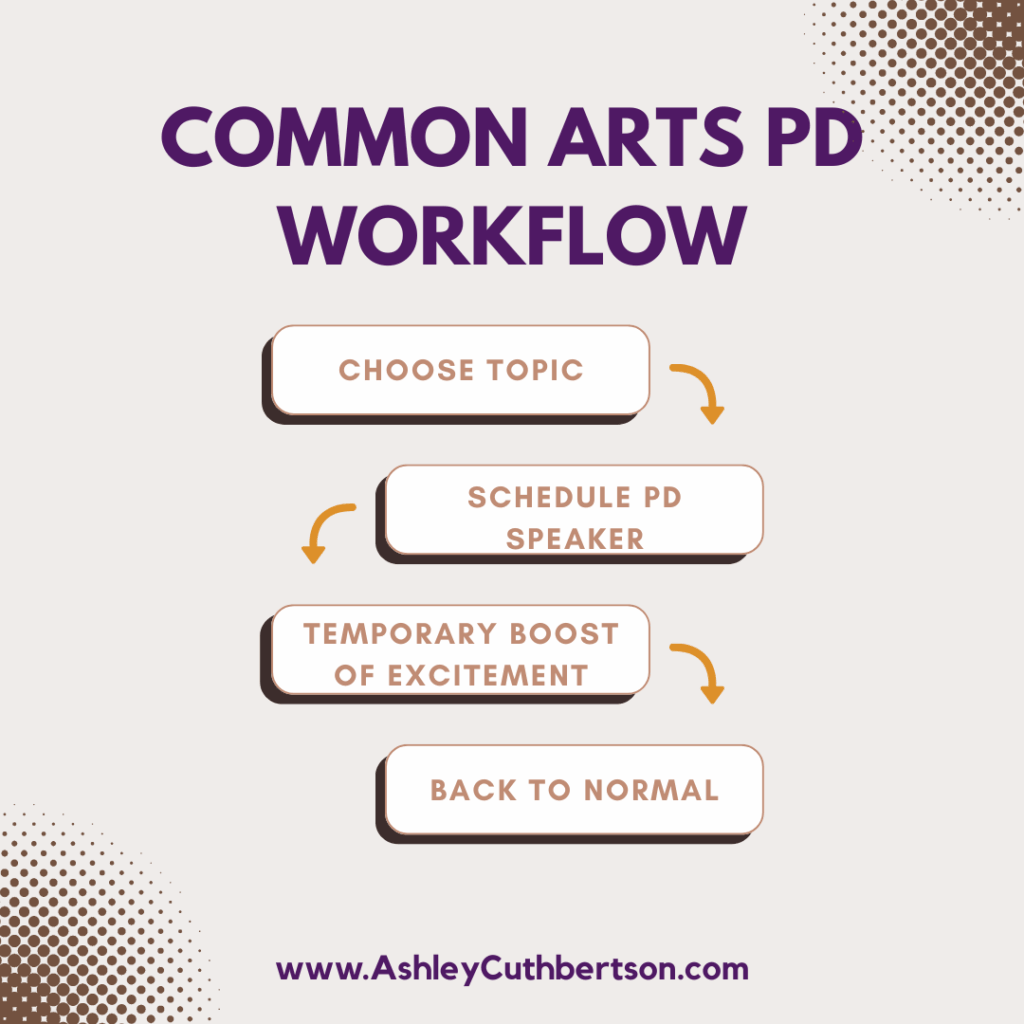
The real problem? Without diagnosis, PD workshop choices are usually assumption-driven. And that creates initiative fatigue for arts teachers. Teachers sit through sessions on “the next big thing” every year, while nothing really changes over time.
And the research about professional learning is clear:
- The Every Student Succeeds Act (ESSA) defines professional learning as “sustained (not stand-alone, 1-day, or short-term workshops), intensive, collaborative, job-embedded, data-driven, and classroom-focused (Every Student Succeeds Act, 2015).”
- Linda Darling-Hammond’s research confirms that it takes 30 to 80 hours of learning to make real change (Darling-Hammond, L., Hyler, M. E., Gardner, M. (2017). Effective Teacher Professional Development).
Yet arts educators are expected to transform after a single workshop. Imagine teaching a single lesson on the Pythagorean theorem in a geometry class and then thinking that the kids have mastered it. That doesn’t work for our students, and it doesn’t work for our teachers, either.
Arts teachers don’t need piecemeal workshops to fill a PD day. They need intentional, ongoing professional learning tied to their real needs.
Beyond PD: Other Levers That Improve Arts Education Programs
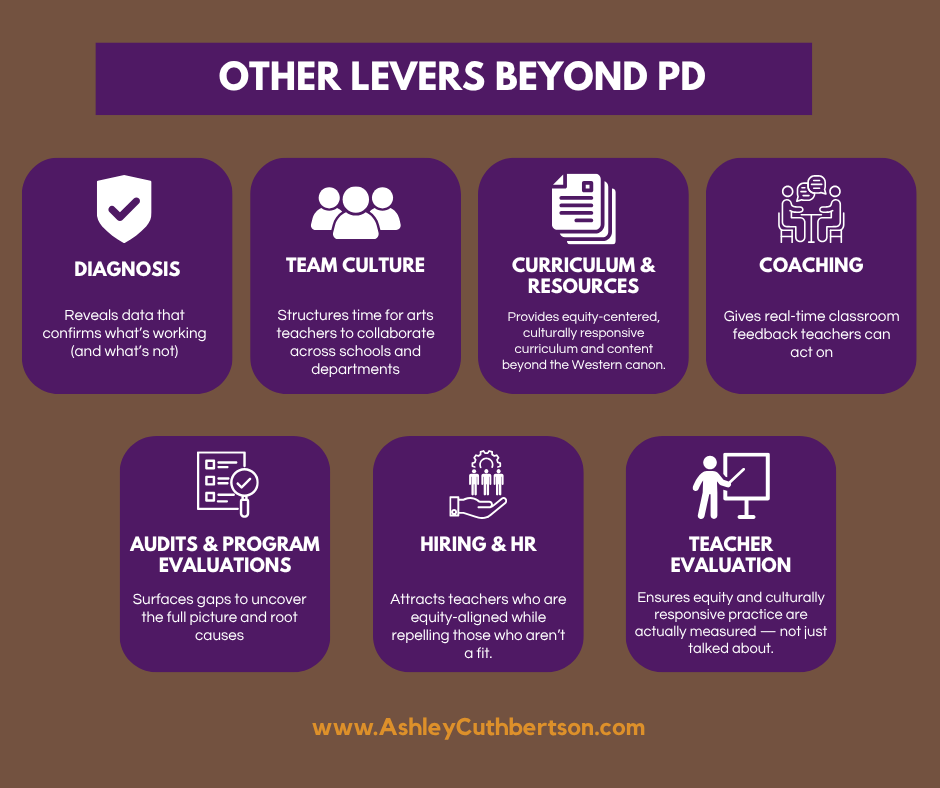
PD isn’t the villain – but it’s not the whole answer. When leaders are quick to schedule another speaker or PD workshop, they actually miss other levers they could pull that may make a bigger impact on the solution they’re seeking.
Here are levers arts leaders often overlook when they default to another workshop:
- Diagnosis. I see leaders skip over this critical first step all the time. But it doesn’t have to be intimidating, or even a full blown program audit, it could be as simple as a three-question student survey to clarify what’s really happening. Without this step, leaders are guessing and hoping what they choose will resonate; but hope isn’t a strategy.
- Team culture. Arts teachers are often the only one of their subject in a building. One of the most powerful things leaders can do is to create regular, structured collaboration across departments and schools so that arts educators can share best practices and support each other.
- Curriculum and resources. Sometimes the challenge isn’t teacher mindset or strategies – it’s the curriculum. Arts teachers may want to center culturally responsive practices, but lack the resources to do so effectively. If curriculum hasn’t yet been intentionally designed to support culturally responsive learning tasks, or if content options don’t yet move beyond the traditional Western canon, no amount of PD will solve the gap.
- Coaching. Workshops are great for knowledge and skill-building, but they’ll never give a teacher real-time feedback on their instructional delivery. Instructional coaching bridges that gap — helping teachers take strategies from theory into practice with real kids.
- Audits & program evaluations. Strong classroom pedagogy can still hide systemic problem spots. In one high school music program I performed an audit for, enrolled students loved the music courses! But interviews with students not enrolled in music courses revealed a serious opportunity: they didn’t see music courses as being a place for them. A PD workshop never would have uncovered that.
- Hiring & HR. Strong arts programs don’t just hire top talent – they hire aligned talent. Job postings, public branding, course offerings, and even interview questions all send signals. If they communicate a more narrow view, programs will repel the kind of diverse, innovative candidates you’re looking for.
- Evaluation. If equity and culturally responsive practices matter, then teacher evaluation systems must explicitly measure them. Otherwise, we send a mixed message: “this matters in theory, but not in practice.”
When leaders treat PD like the magic bullet, they risk missing opportunities to pull levers that address important areas across systems.
The First Step in Improving Arts Professional Development
Here’s the thing: you can’t prescribe before you diagnose.
Too often, I see leaders pouring precious budget dollars into another workshop without asking: what challenge are we actually trying to address? What data confirms this challenge? Diagnosis is what provides clarity on what’s actually needed. It affirms what’s already strong, so we don’t waste energy fixing what isn’t broken, and it points directly at the areas that do need attention.
It’s like going to the doctor because you have an earache and asking for vitamins. Vitamins are nice, but if you have an earache, you need a painkiller. Think of effective professional learning the same way. Without diagnosis, leaders risk prescribing “feel-good vitamins” instead of the painkiller that will actually provide a solution to a challenge.

I saw this firsthand recently when I worked with a Youth Orchestra leadership team. They were torn between two urgent priorities: student engagement and teacher buy-in. As the discussion continued, I stopped them to tell them a hard truth: the tension you feel is because we don’t yet have concrete data to point us towards what needs more attention first.
I’ve seen many arts leaders and leadership teams run into a similar situation where they have a beautiful, bold vision for culturally responsive and equitable practices in their programs, but are having a hard time knowing what priorities to concentrate on.
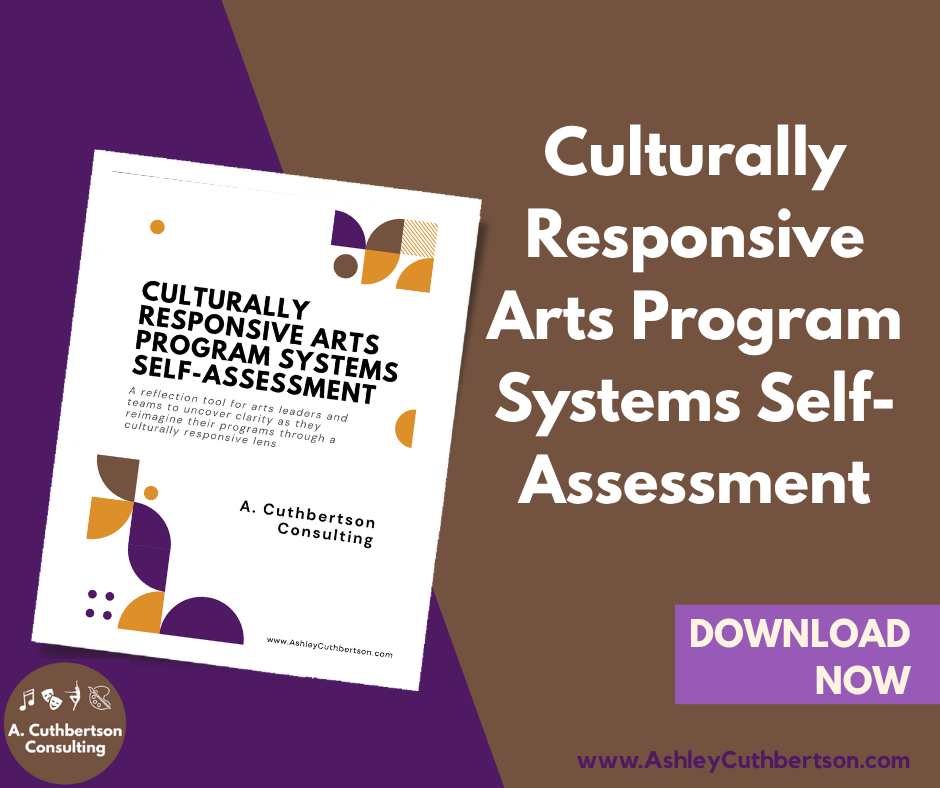
That’s why I created the Culturally Responsive Arts Program Systems Self-Assessment Tool. It’s designed to help arts leaders and teacher-leaders pause and reflect on the bigger picture – and it’s equally powerful for classroom arts teachers who may be doing this work on their own. The tool helps you to pause, reflect, and gather evidence in four key areas:
- Mindset & Orientation for Equity in the Arts
- Learning Environment & Arts Program Culture
- Content, Curriculum & Instructional Practices in the Arts
- Systems & Sustainability for Culturally Responsive Arts Programs
It’s not about creating a massive report. It’s about asking focused questions, making note of what evidence you already have, and letting that guide your next step.
Why Data-Driven Professional Learning Works for Arts Teachers and Leaders
When professional learning is driven by “vibes”, arts teachers feel like their time is just being filled. But, when it’s data-driven, they feel like their growth is being prioritized.
Arts teachers need to know the “why” just as much as students do. This is where the data and diagnosis comes in: when they see how the data clearly points to an area of growth, professional learning has a clear purpose. It’s not another disjointed workshop to fill the PD day – instead it’s connected to a priority that matters. This is how we ensure teachers don’t feel that PD is wasting their time. Instead, they’ll feel respected as professionals.
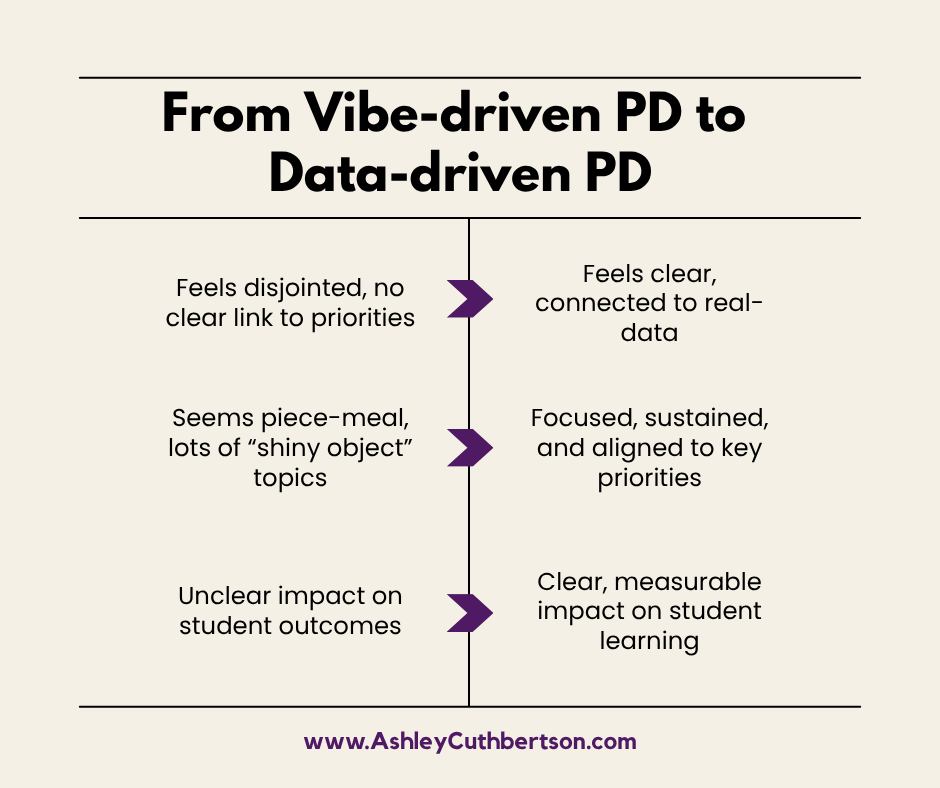
And there’s ROI for arts leaders when we approach sustainable professional learning in arts education with a data-driven lens, too. Instead of spreading your energy across ten different initiatives, diagnosis helps you focus on the two or three that will actually move the needle towards your vision. And because you have data on where things started, you’ll know whether progress is happening and why.
Diagnosis builds trust. It ensures PD isn’t just a guess – it’s a strategy pulled to align energy with the most urgent needs.
Setting the Stage: Your Next Step in Improving Arts Professional Development
A PD workshop is not always the answer. But when it is, leaders must be clear about why you landed there. Anything less is a guess. And guessing with teachers’ time and energy is what leads to frustration and resistance to professional learning.
If this feels uncomfortable, that’s normal! The work of equity and culturally responsive practice calls us to do things differently and that means we must lean into discomfort. Discomfort isn’t a stop sign, it’s an invitation to get curious.
And the good news is that you don’t have to figure it out on your own! Download the Culturally Responsive Arts Program Systems Self-Assessment Tool. Use it with your team, let it uncover where your greatest strengths & opportunities are, and let that clarity guide you to your next move.
At the end of the day, professional learning isn’t about filling time on a PD calendar. It’s about building arts programs that attract and retain aligned talent, honor teacher expertise, and most importantly, transform students’ lives by showing every student what’s possible in and through the arts.
What would be possible if your arts program was built on that kind of foundation?
The future of arts education won’t be built on one-off workshops, but on programs bold enough to reimagine what’s possible.
References
Every Student Succeeds Act, 20 U.S.C. § 6301 (2015). https://www.congress.gov/bill/114th-congress/senate-bill/1177
Darling-Hammond, L., Hyler, M. E., Gardner, M. (2017). Effective Teacher Professional Development. Palo Alto, CA: Learning Policy Institute).