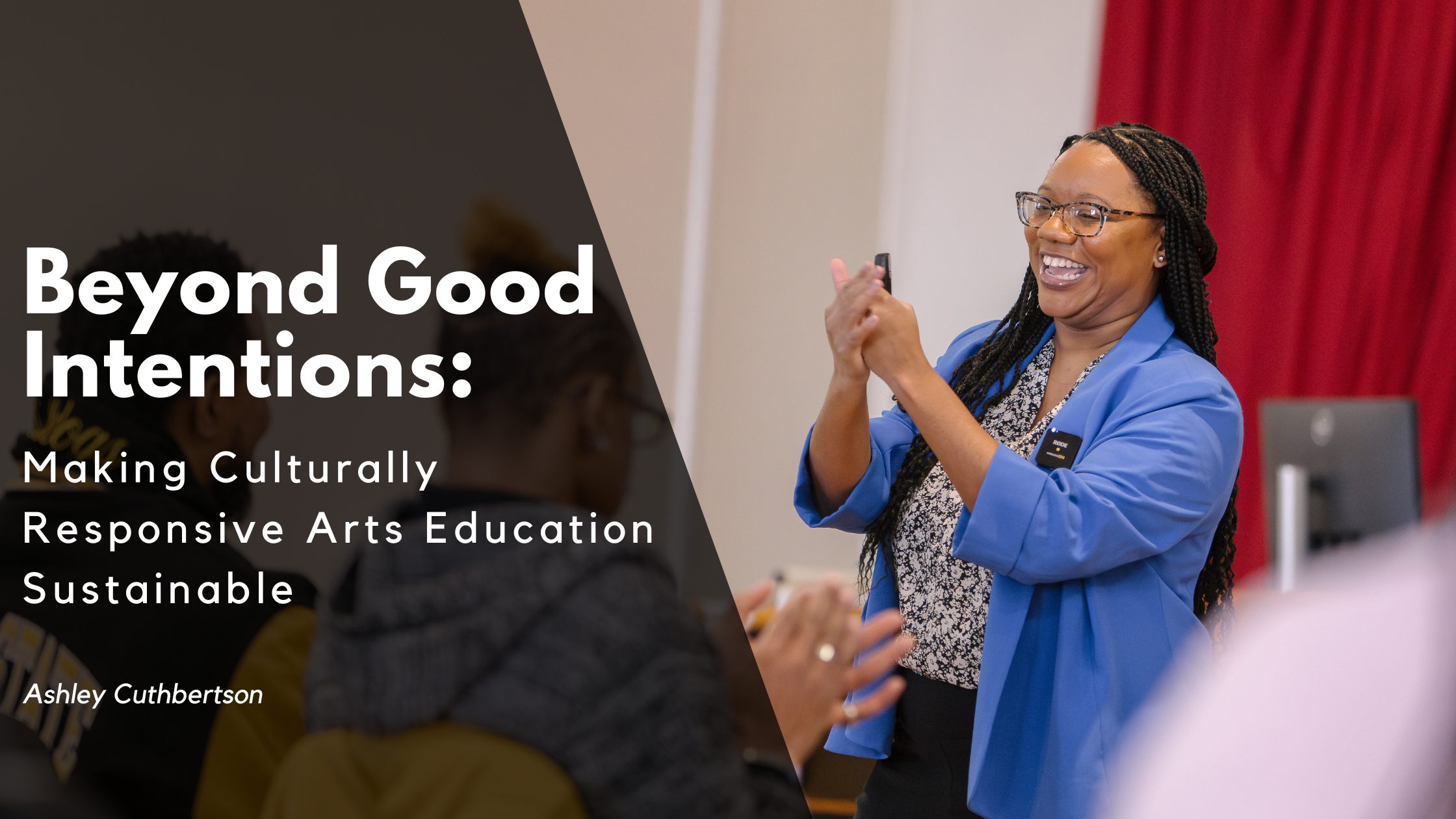
What often looks like a culturally responsive arts program is really just a culturally responsive person. And those are not the same thing.
An arts teacher who fosters a culture of belonging for all learners, consistently brings diverse content into the curriculum, and removes obstacles and barriers to success for all learners is carrying a lot on their shoulders.
But when the strength of an arts program relies on the knowledge and efforts of one person, that program is unsustainable.
In education, the conversation of burnout often discusses things that individuals can do: things like self-care and having better boundaries. But burnout is really a symptom of a bigger problem: a lack of systems. And systems are what makes a high-quality, culturally responsive arts program sustainable regardless of who is leading the classroom.
The Real Danger of Burnout to Culturally Responsive Arts Education
Burnout in arts education isn’t a mystery. It’s something you can trace back to specific structural absences.
When there’s no system for curriculum, arts educators are building their own alone at 10pm. When there’s no system for ongoing learning, growth depends entirely on that teacher’s willpower, desire, and capacity. When there’s no system for coaching and support, every tough decision is carried alone.
Arts educators carry a tremendous load every day. They’re juggling the needs of hundreds of students daily, coming in early for rehearsals, working through lunch to reset materials for the next class, and staying after school to prepare students for an upcoming show. Often going above and beyond to provide the best quality arts experience that they can for their students outside of their contracted hours. On the surface, we see a dedicated educator. Underneath, there’s a silent countdown to burnout and an unsustainable situation for the arts program as a whole.
Burnout in arts educators is not only a threat to the well-being of the teacher, it’s a threat to the quality of the arts program and makes it virtually impossible for students to have consistent, equitable access to high-quality arts learning, because the quality of the arts program is only ever as strong as the person currently holding it all up.
When the arts educator is struggling to juggle all the demands of their position alone, the learning environment suffers, the instruction suffers, and ultimately the students suffer.
Ensuring that culturally responsive arts education is sustainable isn’t about teachers having better boundaries. It’s about whether a system exists that can run regardless of who’s in the classroom. If one person transferring schools means everything they were doing leaves with them, the system was never built to last in the first place.
3 Keys to Creating Sustainability for Culturally Responsive Arts Education
The solution to creating sustainability for high-quality, culturally responsive arts programs isn’t for arts educators to “work harder”, and it’s not an occasional PD day or a grant-funded initiative. The solution is to intentionally build systems that ensure a high-quality, culturally responsive arts program that doesn’t depend on the capacity, willpower, or efforts of a single person. Because when that one dedicated educator inevitably burns out, transfers schools, or retires, the whole arts program leaves with them.
Sustainability comes from systems that are intentionally built to hold up the integrity and quality of an arts program that centers culturally responsive arts education in three key areas: learning, resources, and support.
Learning
Strong arts educators are also lifelong learners. However, arts educators are often on their own to find content-specific professional learning to support their goals and to find the time and capacity to engage.
A strong system of professional learning for arts educators continually diagnoses, plans for what is most needed, and reviews the data on how that learning is impacting teachers’ practice. That data then drives what comes next, ensuring that learning stays ongoing and responsive to arts educators’ goals and needs. Most importantly, it ensures the learning is having a measurable, positive impact on student learning, not just a fun PD day.
Professional learning is most effective when it is content-specific to arts education and considers the goals and needs of the arts educators to select what professional learning is most needed and the format that makes the most sense.
Instead of defaulting to another PD day just because it’s on the calendar, this could look like a Monthly Arts Professional Learning Community with clear structures and goals for learning, regular time to collaborate on curriculum development, a quarterly meeting to ensure everyone on the arts team is aligned, or access to asynchronous professional development options that can be completed at their own pace.
Resources
Many arts educators aren’t provided with a clear scope and sequence or curriculum, and as a result must create their own. The demands of creating curriculum aligned to standards is time consuming and also means that the curriculum only lives in their head and files, so when they leave the program, the curriculum leaves with them.
A strong system of instructional resources is built on a well-documented curriculum with accompanying materials, housed institutionally, not individually. This includes the story behind the decisions: why this scope and sequence? Why these units and assessments?
Documentation is what determines whether a program’s quality survives teacher turnover or resets to zero every time someone leaves. When the reasoning is written down instead of living only in one person’s mind, the next teacher, and the next leader, can pick it up instead of starting from a blank page. That’s the difference between a program that dips in quality every time there’s a staffing change, and one that holds steady no matter who walks through the door.
In practice, this could look like a shared curriculum drive where every unit includes not just the plan but the reasoning behind it, a scope-and-sequence review built into onboarding for every new arts hire, or an annual protocol for updating and improving materials rather than rebuilding them from scratch each year.
Support
Often arts educators are “the only” in their building, sometimes even in their district. That feeling of “being on an island” not only means that they’re constantly second guessing every decision they’re making, but it also means they are often the sole person responsible for championing and advocating for the arts.
A strong system of support is built on defined policies, structures, coaching, and community, providing the same infrastructure to the arts that are given to other subject areas like language arts and math.
This matters because isolation doesn’t just wear an educator down, it puts the entire arts program at risk. Decisions made in a vacuum are decisions made without a second set of eyes to catch what’s missing. And when the arts educator is also the only advocate for the program, that advocacy disappears the moment they do. A system of support ensures the arts have a voice in the building that doesn’t depend on one person having the energy to keep raising it.
This could look like providing support for arts educators to regularly attend networking events and conferences so they can build relationships and community, including arts educators on the instructional coach’s schedule on an ongoing basis not only when things are off-track, or quarterly meetings with administrators and the arts team to ensure that everyone is on the same page.
Leaders: for each of the three keys reflect: if your most dedicated arts educator left tomorrow, what happens to the arts program? Consider what system might be missing. Pick one of those gaps and ask your arts teacher directly “what’s one thing you’re currently holding together on your own that shouldn’t depend on you?” Then build the necessary system.
Teachers: Which of the three keys depends solely on you? What would need to be true in order for there to be a system that doesn’t depend on you? Bring that specific ask to your leader, not “I need more support,” but, “here’s what needs to exist in order for this program to thrive whether I’m here or not.”
Systems Make Culturally Responsive Arts Education Possible
When culturally responsive practices are built into systems instead of relying on the efforts of a single person, the conversation about arts education changes completely. The conversation is no longer about whether or not the arts program will survive the next budget cycle or leadership change. Instead, it’s about how the arts program is an integral part of a well-rounded education for every learner in the school.
That’s the difference between a culturally responsive person and a culturally responsive program. One is a story about a dedicated arts educator. The other is a story about infrastructure that’s built to last.
This is the fifth and final article of a five-part series on building arts programs where culturally responsive practice is visible, measurable, and sustainable. If this resonated with you, I’d love to have you join the conversation! Subscribe to my weekly newsletter for deeper dives, behind-the-scenes thinking, and the conversations happening in the field — the kind of stuff that doesn’t make it into the blog.
Are you a leader looking for support to make culturally responsive practice visible, measurable, and sustainable in your arts program? Book a discovery call and let’s talk about what that could look like for your program.